

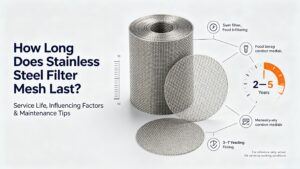
If you use stainless steel filter mesh for water treatment, food processing, chemical filtration, or industrial screening, you may wonder: how long does stainless steel filter mesh last in actual working conditions?
Unlike plastic and nylon filter materials, stainless steel mesh features high tensile strength, rust resistance, and wear resistance. However, its actual service life varies greatly based on material grade, working medium, environment humidity, and daily maintenance.
In this complete guide, we share the accurate service life of 304 and 316/316L stainless steel filter mesh in different scenarios, key influencing factors, and practical ways to extend mesh lifespan.
1. Standard Service Life of 304 & 316L Filter Mesh
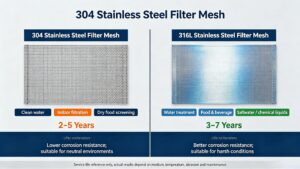
304 Stainless Steel Filter Mesh
• Clean water, indoor filtration, dry food screening: 2 – 5 years
• Humid outdoor, light salt and weak acid environment: 1 – 2 years
304 mesh is the most cost-effective option for general industrial filtration. It maintains stable performance in neutral environments but is vulnerable to chloride corrosion.
316 / 316L Stainless Steel Filter Mesh
• Normal water treatment, food and beverage filtration: 3 – 7 years
• Seawater, salt water, chemical liquid, wastewater filtration: 2 – 4 years
With molybdenum content, 316L mesh delivers excellent anti-corrosion and anti-rust performance, making it the best choice for harsh industrial filtration.
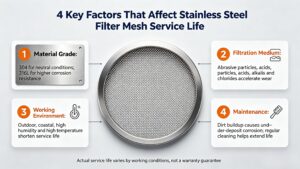
2. 4 Key Factors That Affect Filter Mesh Service Life
1) Stainless Steel Material Grade
Material grade determines the basic anti-rust and anti-corrosion ability.
304 fits neutral environments; 316L performs far better in salty, acidic, and coastal environments.
2) Filtration Medium
Solid particles, abrasive impurities, acidic or alkaline liquid, and chloride content will accelerate mesh wear and pitting corrosion.
3) Working Environment
Indoor dry conditions greatly extend service life.
Outdoor, coastal, high humidity, and high-temperature environments speed up oxidation and corrosion.
4) Daily Cleaning & Maintenance
Most filter mesh fails early due to dirt accumulation instead of material quality problems.
Regular cleaning effectively avoids blockage, oxidation, and local rust points.
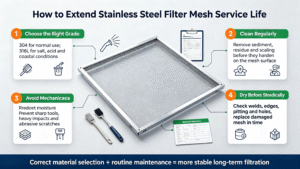
3. How to Extend Stainless Steel Filter Mesh Service Life
• Choose the correct grade: 304 for normal use, 316L for salt, acid and coastal conditions
• Clean the mesh regularly to remove sediment, residue and scaling
• Avoid sharp hard objects scratching the wire and causing deformation or breakage
• Dry the mesh after cleaning before storage
• Inspect welds and edges regularly; replace the mesh once pitting or holes appear
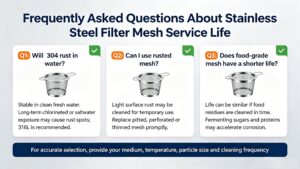
FAQ
Q: Will 304 stainless steel filter mesh rust in water?
A: It is stable in clean fresh water. It is easy to get rust spots in long-term chlorinated or saltwater environments, so 316L is recommended.
Q: Can I keep using the filter mesh after rust appears?
A: Light surface rust can be cleaned for temporary use. If pitting, perforation or thin wires are found, replace it promptly to prevent leakage.
Q: Does food-grade stainless steel filter mesh have a shorter service life?
A: The service life is similar if food residues such as sugar and protein are cleaned in time. Residue fermentation will accelerate corrosion.
Conclusion
As a reference, 304 stainless steel filter mesh generally lasts 2–5 years, while 316L stainless steel filter mesh can reach 3–7 years under suitable conditions.
Correct material selection plus routine maintenance is the key to stable long-term filtration performance. Send us your working condition details, and we can recommend the suitable stainless steel filter mesh for your project.