

If you are looking for high-quality stainless steel filter mesh for industrial filtration, water treatment, food processing, chemical engineering, or marine equipment, you will always face a choice between 304 stainless steel mesh and 316 stainless steel mesh.
They look almost the same in appearance, but their chemical composition, corrosion resistance, service life, and applicable working environments are significantly different. Choosing the wrong material will cause rust, mesh damage, frequent replacement, and increased project costs.
This article systematically compares 304 and 316 filter mesh to help you pick the most cost-effective grade for your project.
1. Chemical Composition Difference
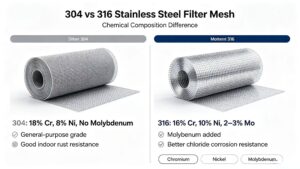
304 Stainless Steel Filter Mesh
304 grade contains 18% chromium and 8% nickel, with no molybdenum.
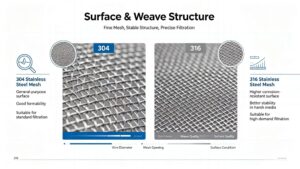
It is the most common general-purpose stainless steel material with stable structure, good weaving performance and excellent indoor rust resistance.
316 Stainless Steel Filter Mesh
316 grade contains chromium, nickel, and 2%–3% molybdenum.
The added molybdenum greatly improves resistance to chloride, salt water, acid and alkali corrosion.
2. Corrosion Resistance Difference
304 Mesh
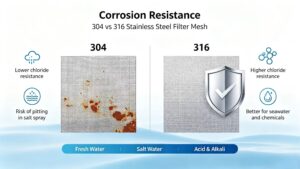
304 mesh performs well in normal atmospheric environments, dry indoor conditions and fresh water filtration.
However, it is not resistant to salt spray, seawater and chemical liquids, and is easy to produce pitting rust in coastal and humid areas.
316 Mesh
316 stainless steel filter mesh provides superior anti-corrosion performance.
It is specially designed for chloride-rich environments, seawater, sewage, acid and alkali liquid filtration.
It can resist rust and damage in coastal, marine and chemical industrial environments for a long time.
3. Service Life & Durability
304 Mesh
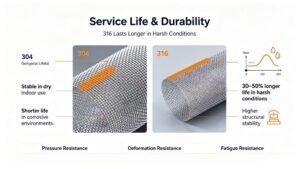
Long service life under normal indoor and dry industrial conditions.
Service life will be greatly shortened in humid, salty and corrosive environments.
316 Mesh
316 filter mesh has 30%–50% longer service life than 304 in harsh working conditions.
It features high structural stability, deformation resistance, and pressure resistance during long-term filtration.
4. Application Scenarios
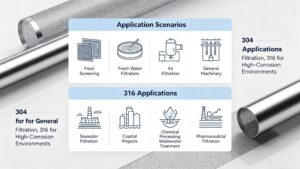
304 Stainless Steel Mesh Applications
• Food dry material screening, grain filtering
• Ordinary domestic water filtration
• Air filtration and dust separation
• General industrial mechanical filtration
• Indoor and non-corrosive environment use
316 Stainless Steel Mesh Applications
• Seawater filtration and marine engineering equipment
• Coastal salt spray environment projects
• Chemical acid and alkali liquid filtration
• Industrial wastewater treatment
• Medical, pharmaceutical and high-end food filtration
• Outdoor long-term anti-corrosion filtering system
5. Price & Cost Performance
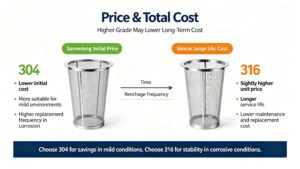
304 filter mesh has lower material cost and higher cost performance for conventional projects.
316 filter mesh contains higher nickel and molybdenum content, so the unit price is slightly higher.
However, for corrosive environments, 316 avoids frequent replacement and maintenance, achieving lower overall long-term cost.
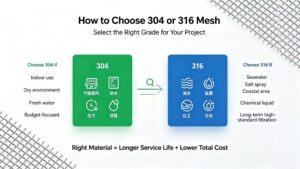
6. How to Choose 304 or 316 Mesh
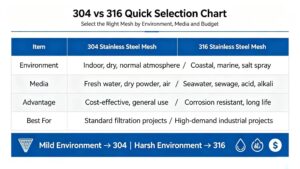
Choose 304 if
Your project is indoor, dry, freshwater, non-corrosive and budget-sensitive.
Choose 316 if
Your project involves seawater, salt spray, coastal areas, chemical liquid, sewage, or high-standard long-term filtration requirements.
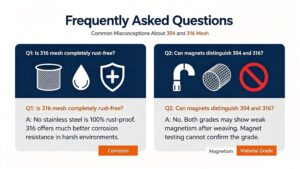
7. FAQ
Q1: Is 316 mesh completely rust-free?
A: No stainless steel is 100% rust-proof. 316 provides far better anti-rust performance than 304 in harsh environments.
Q2: Can magnets distinguish 304 and 316?
A: No. Both 304 and 316 may have weak magnetism after weaving. Magnet testing cannot identify material grades.
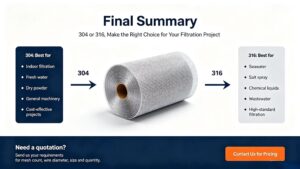
Conclusion
304 stainless steel filter mesh is the best choice for ordinary indoor and non-corrosive filtration projects with high cost performance.
316 stainless steel filter mesh is the premium solution for seawater, coastal, chemical and high-corrosion industrial filtration.
We supply full sizes of 304 and 316 stainless steel filter mesh with customized mesh counts, wire diameters and sizes. Contact us for free quotation.